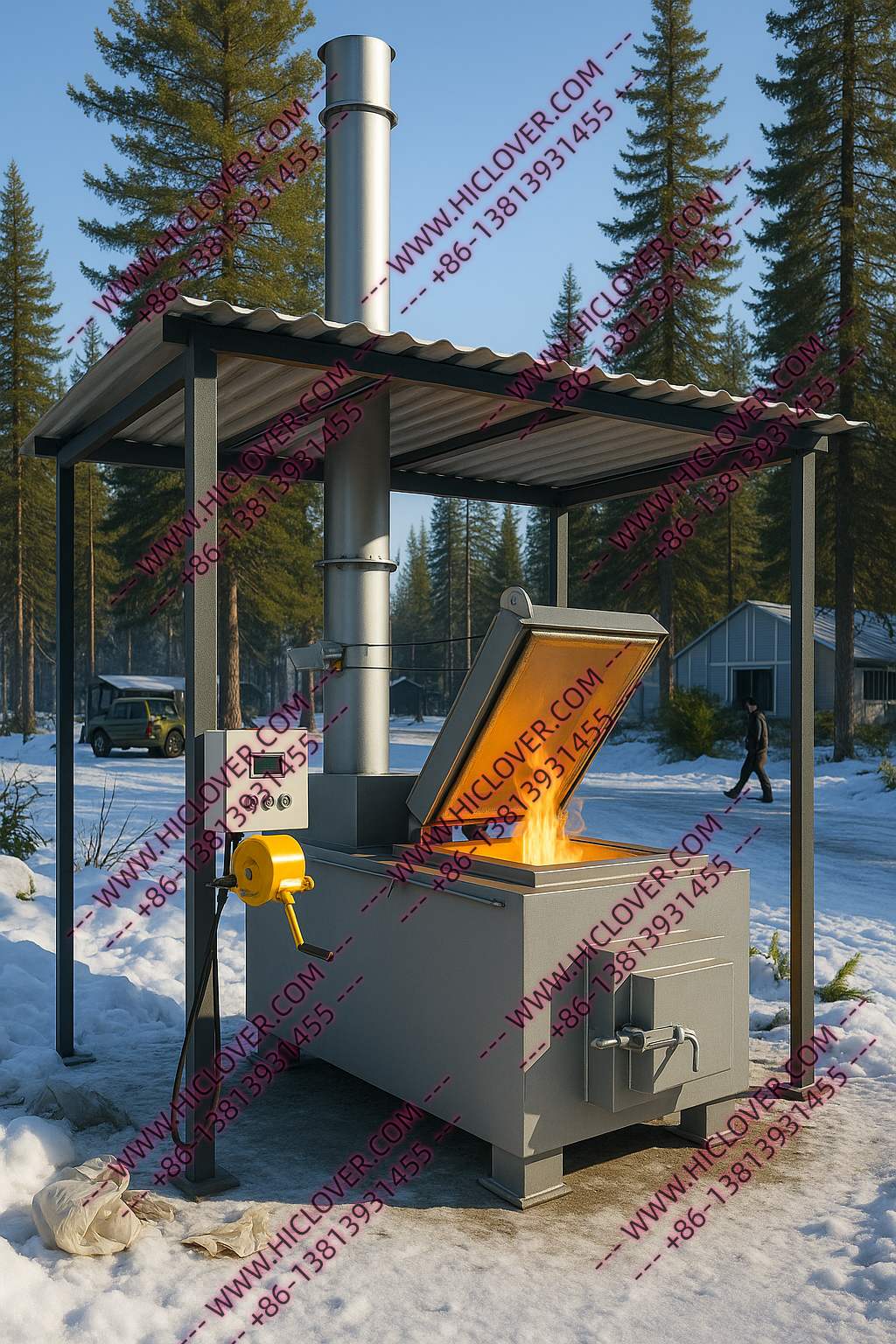
PLC Controlled Hospital Incinerator Systems in Daily Healthcare Operations
In hospital environments, medical waste handling is not an abstract policy issue but a daily operational task. Used syringes, contaminated dressings, pathological residues, and expired pharmaceuticals must be treated quickly to reduce infection risk for staff and patients. In many facilities across Ghana, incineration remains a practical and commonly adopted method because it allows on-site treatment without relying on complex external logistics.
For procurement teams and hospital engineers, searches related to a PLC controlled hospital incinerator Ghana are often driven by one concern: how reliably the system can operate with limited manpower, variable power supply, and strict attention to smoke, odor, and safety.
Why PLC Control Matters in Hospital Incineration
Traditional manually operated incinerators depend heavily on operator experience. In hospitals where staff rotation is frequent and technical training time is limited, this creates operational risk. PLC-controlled systems address this by embedding operating logic directly into the control platform.
A PLC controlled hospital incinerator uses programmed sequences to manage burner ignition, temperature ramp-up, combustion holding time, and safe shutdown. This reduces manual intervention and helps maintain consistent operating conditions during daily waste disposal routines.
Combustion Structure Commonly Used with PLC Systems
Primary and Secondary Chambers
Technical configurations typically begin with a dual-chamber layout. The primary chamber is designed for direct combustion of medical waste and normally operates at temperatures around 850 °C. This stage focuses on waste volume reduction and destruction of infectious materials.
Downstream, a secondary chamber operates at higher temperatures, often approaching 1100 °C. Its role is to re-burn flue gases generated in the primary chamber. By sustaining high-temperature oxidation, the secondary chamber helps reduce odors and visible smoke linked to incomplete combustion. This structure is a commonly adopted configuration for hospitals and is designed in line with common healthcare waste management practices.
Temperature Stability Through Automated Logic
PLC control is closely linked to temperature stability. Sensors continuously monitor chamber conditions and feed data back to the control unit, which adjusts burner output accordingly. This closed-loop logic supports steady high-temperature operation even when waste composition varies.
In facilities where grid power can be unstable, diesel-fired burners are frequently specified. Technical descriptions often explain how fuel-based combustion systems maintain thermal continuity independent of electrical fluctuations, a practical consideration for many hospitals.
Operator Safety and Reduced Manual Dependence
From an operational standpoint, PLC-controlled incinerators are designed to lower reliance on constant human oversight. Interlocks prevent unsafe actions such as door opening at elevated temperatures, while alarm functions notify operators of abnormal conditions.
For small hospitals and clinics, this automation reduces training requirements. For regional hospitals with higher waste volumes, it supports extended daily operation without increasing staffing levels.
Flue Gas Treatment Options Integrated into PLC Control
Emission control is another area where PLC systems add value. Dry flue gas treatment units are often presented as baseline options, offering acid gas neutralization with relatively simple maintenance. For projects with stricter performance expectations, wet scrubber systems may be integrated.
Documentation typically explains how the PLC coordinates auxiliary equipment―such as pumps or fans―ensuring that gas treatment stages operate in sync with combustion. These options are described without absolute compliance claims, allowing project owners to align configurations with local review processes.
Application Across Different Hospital Scales
A PLC controlled hospital incinerator is not limited to large facilities. Compact, containerized units are frequently selected by clinics and small hospitals seeking minimal civil work and faster installation. Regional and teaching hospitals may adopt larger systems designed for continuous or semi-continuous operation.
Across these scales, the control philosophy remains consistent, which simplifies spare parts planning and operator familiarization when multiple facilities are managed under a single healthcare authority.
HICLOVER as a Manufacturing Source
HICLOVER operates as a manufacturing factory supplying standardized hospital incinerator models with PLC-based control systems for export markets. Rather than one-off designs, its equipment follows repeatable configurations supported by technical manuals, control logic descriptions, and remote coordination during installation and commissioning.
System overviews, configuration options, and general technical information are available through the official website:
https://www.hiclover.com/
This manufacturer-focused approach supports hospitals, EPC contractors, and NGOs that rely on English-language technical searches when evaluating incineration solutions.
Practical Considerations for Project Evaluation
When reviewing a PLC controlled hospital incinerator in Ghana, decision-makers typically look beyond nominal capacity. Attention is given to how automation supports safe operation, how combustion stages are controlled, and how emission-related concerns such as black smoke and odor are addressed in routine use.
For hospitals operating under real-world constraints, PLC control is less about advanced electronics and more about predictable, repeatable daily performance within existing healthcare infrastructure.